Biography of St. Thomas Aquinas
St. Thomas Quinas was a 13th Century theologian and philosopher, greatly recognized as one of Catholicism's most influential minds. Born near Aquino, Italy (circa. 1225-1227), Aquinas was raised to follow in his family's noble footsteps beginning monastery school at the age of five. He studied at the University of Naples for six years until he became intrigued by the revolutionary Dominican Order which he then decided to follow, to the dismay of his family, when he turned 16. This decision angered his family to the point that while on his way to Rome, Aquinas was kidnapped by his brothers and taken back to the family castle. He was bound there for one year as his family attempted to persuade him (through prayers, threats, and even sexual temptation) not to join the Dominican Order. However, through the intervention of the Dominican Pope Innocent IV Aquinas was released and free to begin his study of the Dominican Order in Cologne in the year 1244.
Accompanied by his mentor, Albertus Magnus, he traveled to the University of Paris in 1245 to continue his study of the order for another three years. Around 1248, Magnus was appointed head of a new Dominican chapter in Cologne and in turn named Aquinas as his Bachelor of Theology, a position second only to Magnus. A year later Aquinas was brought into priesthood and began giving lectures, sermons, and homilies regularly. The following year marked the beginning of his illustrious career as he was sent to Paris to take position as Bachelor in the Dominican chapter. It was during this time that he began to compose his magnum opus, the "Summa Theologica."
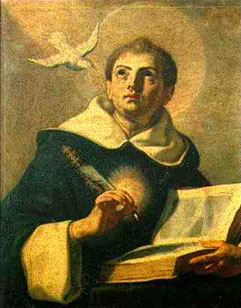
A young Thomas Aquinas.
After being named a Doctor in Theology by the Univeristy of Paris in 1257, Aquinas began to rise to celebrity status throughout Europe. He traveled aduously to serve the Dominican Order by preaching in France, Italy, and Germany, all the while composing the "Summa Theologica" and other works. Slowly he began gaining recognition by head figures in the Church, becoming so prominent that the Church offered him the positions of Archbishop in Naples as well as Aboot of Monte Cassino, both of which he refused.
St. Thomas Aquinas died on March 7, 1274 in Lazio, Italy without ever completing his "Summa Theologica." Nevertheless, he was able to construct over 50 works in his name, making his impact on Christianity and the general evolution of thought undineiable and surprisingly relevent even to this day. There are universities, communities, and churches named in his honor; his teachings are requisite for those looking to become priests; the unfinished "Summa Theologica" was placed on the alter alongside of the Bible and the Decretals at the Council of Trent, not to mention the myriad of writers, thinkers, and everyday people impacted by his teachings. Aquinas is solidified as one of the greatest thinkers in Western philosophy.
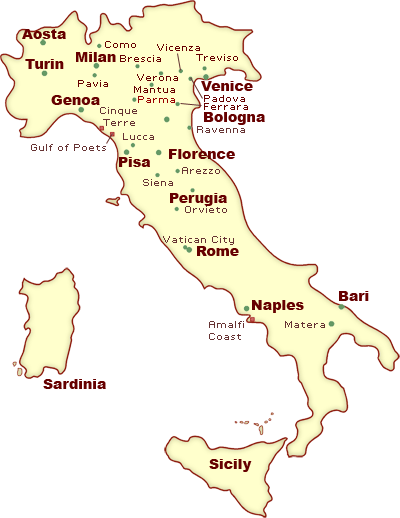
Aquinas was born in Aquino, a town in southern Italy near Naples.
He died in Lazio, just north of Rome.
Sources:
http://en.wikipedia.org/wiki/Thomas_Aquinas
http://www.ccel.org/ccel/schaff/encyc11/Page_422.html
Site Last Updated: 11/01/2005