
ART 314: ADVANCED DIGITAL ART
SELF-ASSESSMENT 3:
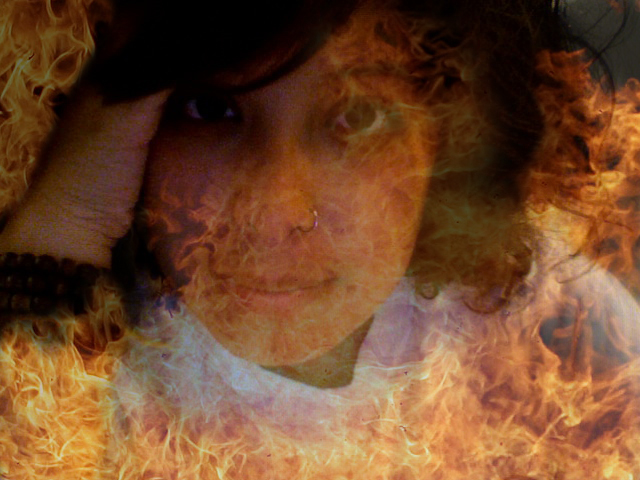
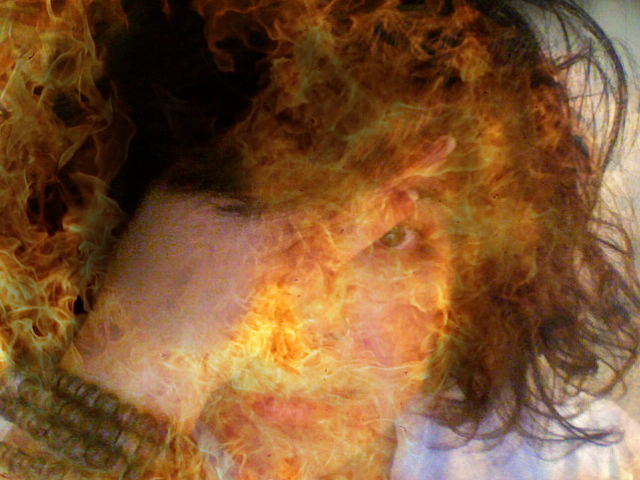
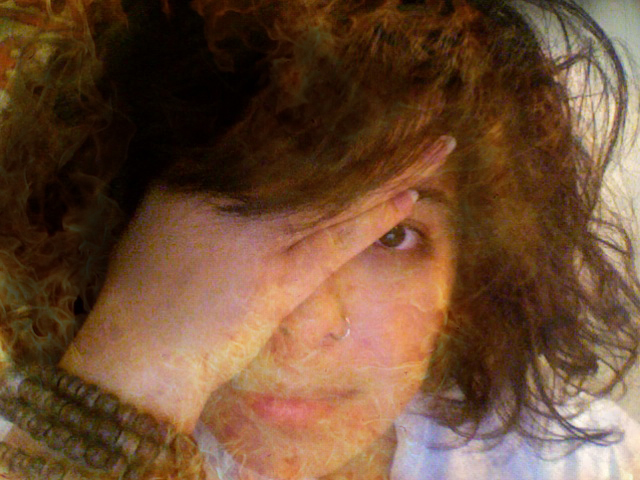
For my final project at St. Mary’s College of Maryland, I chose to create a time-based self-portrait—No-Self, Self-Portrait. This piece explores a concept inspired by my St. Mary’s Project and masking techniques that I have been working on mastering.
The concept that I decided to explore further, outside of my SMP, is the concept of no-self. The idea of no-self comes from Buddhist religion and philosophy, and is perhaps one of the most difficult Buddhist ideas to comprehend. No-self is the idea that one is empty of essence, or any kind of intrinsic quality. During my SMP, I grappled with trying to decipher this idea. I came to the conclusion that the reason it is such a difficult concept to understand is because unlike emptiness (which is that all things are empty of essence), no-self deals with emptiness on a personal level as opposed to a cosmic scale. Telling someone that they are is not anything intrinsic about themselves goes against how most people perceive themselves, and can almost be a frightening concept to confront.
In trying to confront this concept myself, I set out to create a “no-self, self-portrait.” I recalled a parable that I came across at one point about a king and a sage discussing what it means to be empty and not have a “self.” I decided to base my project around this parable, since I have always found it to be the best illustration of this concept.
I attempted to take footage of myself reading the lines of the parable, and creating a dialogue with myself. I thought about taking the lines of the king and reading them in response to another video footage of myself reading the lines of the sage. While I read the lines, the flames that are illustrated in the parable were supposed to appear layered overtop of the images of myself. Syncing the dialogue proved to be a lot more difficult than I had initially thought it was going to be, but I still liked the idea of confronting, or interacting, with myself.
I then decided to change up my idea a little bit and wanted text to appear over the footage of two images of myself, facing myself. The text was supposed to appear as the flames went up and down, and eventually disappeared. I went ahead and took video footage of myself from the viewpoint of a profile shot. This time, I did not say anything, but instead took various shots of myself looking straight ahead. Eventually, the footage would be edited in a way that two images would face each other and interact with how I saw myself.
My revised idea was to figure out a way to make the text somewhat interactive. A couple of years ago for Introduction to Digital Art (ART 214), I did an art post on an interactive website, http://www.abecedariumnyc.com/. Clicking on Bibliomancy, you see a very short clip of pages from a phonebook turning. When you hover your mouse over this image, you see dozens of names flying out of the pages. I tried to work with Adobe Flash and Action Script to create a similar effect of certain key sentences from the parable to come out of the fire. Unfortunately, I found out that what I wanted to do could only be done with After Effects. So, I proceeded to revise my idea again.
I had the foundation of the clip ready to go. The two videos of myself facing each other became one video, and is masked in inversed colors so as to illustrate the idea of being the same, yet different. The flames, layered overtop, worked out the way I wanted it to. The fire is not exactly violent, and the effect of fading in and out serves to not make the image seem nihilistic. I decided to go back to my first idea of talking to myself, and reading the lines of the parable. Tweaking my idea, yet again, I cut down the parable to some key sentences that mainly illustrate the flame that is burning. At that point, I felt like it would be a good idea to add a voiceover to the section when the flames are present. This actually worked out really well, considering the limitations I came across.
I think that I gave myself enough time to work through the trial and error process for all of my ideas. I was able to see what worked, what did not work, and find a different approach to convey the message that I was going for. The only thing I really wished for was a little more feedback. I was able to get the general “that looks cool,” but it would have been nice to hear some actual critiques before writing this assessment to make sure that I effectively worked through the issues I came across.
Taking a step back and looking at the artwork as if I did not make it, I can see that the image is some kind of reflective self-portrait. Seeing as how the two images are looking at each other, I can say that they perceive each other in an almost mirror like way. I can tell that they are the same person because of the basic contour outline and because of the movements they making. They are not the same exact movements, so you know that it is not a mirror effect. I believe that the artist perceives herself as different, but still the same. The flames add an interesting effect because the two images of the artist are not responding to the flames, and therefore provide a serine effect. The audio, I assume, is the voice of artist. Her monologue sounds like she read from a scripture of some kind. It gives a philosophical vibe that is a little difficult to comprehend unless you listen to it carefully. Also, the audio playing while the flames are visible makes me think that the audio is imperative to the flames.
I believe that I deserve an “A” for this project. I accomplished what I described in my intention statement, and I was able to maintain my style as an artist. I am proud of this project being my final project as St. Mary’s. I was able to combine my strengths as an artist and provide something worth showing.
ART EVENT POST: SMP SHOW I
I attended the first art SMP presentations, but unfortunately had to leave before the last person presented. The two that I was able to sit for were Remina and Laura’s presentations. Remina’s SMP was something I was really able to relate to because we work with similar mediums and similar concepts. Her presentation of the of looking at how people perceive themselves and the nature of social media networking was very fascinating and something that I can see myself looking further into with my own work. Laura’s presentation was on children’s books, and how she derived inspiration from them to write her own children’s book.
Remina’s topic almost seemed like an anthropological case study. People who use the Internet and social media are a part of their own unique culture. What gave me this impression was her example of the “performance” we display on the Internet. As members of the Internet culture, we often overlook the rituals that practice—so I thought it was interesting how she displayed that.
Laura’s presentation helped me to realize how much it takes to create a successful children’s story. I guess I never really thought about making a children’s book that adults would also be interested in reading. I still enjoy many of the children’s books that I read as a child, but I always that I was still interested in those stories because I grew up with them. I never stopped to think that the stories are written for an adult’s entertainment.
Both presentations were very successful. I learned things that had never really stopped to consider, even thought they are more or less self-explanatory. I think that what really made Remina’s project successful, in terms of her concept, was that sound of all the images were very present and forced you to take a moment to get up close and listen carefully to what you would otherwise miss. Laura’s installation really complimented her book. The setting was very inviting and playfully childlike. It made me feel comfortable and learn about the adventures of a child and her hats.
PROJECT 3: NO-SELF, SELF-PORTRAIT (05.07.12)
INTENTION STATEMENT (04.24.12)
Concealing and revealing is a crucial part of how we socialize and interact as human beings. My artwork explores different ways of visually concealing and revealing images, thus surfacing a hidden meaning or covering up something to create a new meaning. Over the course of this semester, I have experimented with masks as a part of video art. Masking serves as an impermanent method to conceal and reveal information. I plan on continuing to explore this style, applying it to different concepts, and shifting messages. For my final art project of my undergraduate career, I want to use this masking technique to shift the meaning of what most of us may associate as an unpleasant experience and make it something heavenly.
ART EVENT POST (04.18.12): ART ATROCITIES
Jane Blocker is an art historian teaching Art History at the University of Minnesota. She came to SMCM on Thursday, April 12th with her topic titled Eyes of the World: Contemporary Photography and the Ethics of Witness in Rwanda. Her lecture was a part of the 16th Annual Holocaust and Genocide Series for this year. Her presentation included various photographers’ works that detailed the genocide in Rwanda.
She began her talk with a screen shot of the 2004 film Hotel Rwanda. The screen shot was of the scene where the western tourists are being evacuated by western forces and leaving the Rwandans to fend for themselves. As they leave, you see a man with a camera, taking a photo of the Rwandans looking back at them through the window of the bus that they were leaving in. The main point of her lecture was on the act of “looking” and serving as a witness with and without the camera.
Dr. Blocker continued her talk by explaining what that meant. She mentioned how even though these acts were being spread all over big newspapers like the Washington Post and the New York Times, it did not seem to cause a huge impact on the general public. Her argument was that the images created a different kind of witnessing. This act of looking was through the lens of a westerner, which affected their view of seeing the dead as a picture of the dead. They never really witnessed anything but what the camera witness for them.
My favorite part about her lecture was when she brought up photojournalist Alfredo Jaar’s Rwanda Project. Seeing as how people were “witnessing” these events and were doing nothing about it but taking it in as it came, he took a different approach to using his camera and capturing the images that he took in Rwanda. Instead of displaying the images that he took, he wrote descriptions of what the photos detailed. This required people to read what he took photos of, instead of looking at them. I think that this was much more powerful in the sense that it had the potential to make people question the acts in Rwanda more than if the images were the same as the ones that had been displayed all over the news. A different perspective usually catches peoples attention, and I think that Dr. Blocker used this example successfully in explaining the act of looking and witnessing.
RESEARCH 3 (04.17.2012):
Artist 1:
Peter Campus is a video installation artist from New York, New York. After earning his BS in Experimental Psychology from Ohio State University, he went back to school to study film editing and production at the City College Film Institute. Campus worked in the film industry as a production manager and editor in the early 1970s. During this time, he developed an interest for video art and began making his own artwork.
He plays a lot with perspective and frame positioning. Many of his early works show odd perspectives of watching either yourself or someone else. In his piece Shadow Projection (1970s), he discusses how it is meant to play with the idea of the “shadow and the self.” He continues to describe the piece as a way of “never [getting] to know yourself as other people know you.”
In Three Transitions, he shows us three different ways of approaching layering and masking video-editing techniques. It seems like the different camera perspectives are what really makes this video intriguing. Although there are a lot of neat video-editing techniques (especially given the year this was made), I believe that the work is not merely to show the wonders of video-editing/movie-magic. I believe he is rather providing us, his audience, with a different point of view to how you watch the screen. Whenever you are watching something on a screen, your perception is from your point of view—the spectator’s point of view. Showing us two cameras’ perspectives, he is automatically breaking the fourth wall barrier of the spectator’s point of view.
Even though this is one of his first works, it really grasps some concepts of video art that I am currently exploring. The idea of stepping into a different perspective is very fascinating, especially in relation to this upcoming project. However, it is a different kind of perspective that I am trying to instill in my work. After our first critique on our sketches, I realized that I am going to have to find a way to create this piece not supposed to be nihilistic.
Sources:
http://americanart.si.edu/exhibitions/archive/2012/watchthis2/
http://www.artnet.com/artists/peter-campus/biography-links
http://www.youtube.com/watch?v=UqxBgbVgmVQ
http://www.youtube.com/watch?v=Ar99AfOJ2o8
Artist 2:
Szabolcs Szilagyi (Si-La-Gi) is a Hungarian-Swedish contemporary mixed media artist. He studied painting at the Acedemy of Fine Art in Sweden and then continued his studies at the University of Stockholm in Science of Visual Art. He started experimenting with photography and film installation in the1970s.
Si-La-Gi works with dozens of different concepts, but I am most interested in his work with Buddhist art and how he envelops his own artistic style--he refers to his work as "conceptual and philosophy-based art". As a western artist tackling eastern philosophy, religion, and ideology, I am captivated by his work. Si-La-Gi created a wall with the Heart Sutra (a very famous piece of Buddhist script) hand-written across the wall in what seems to be his native language. He actually named it Heart Sutra (1966).
He has remixed Heart Sutra (1966) many times in different way. My absolute favorite, however, is Hanging Garden (2000). Here, you can see how he covers up parts of the wall in circles. In fact, it almost looks as though he erased it parts of the wall completely. The only thing that keeps me from believing that he actually removed those parts of the sutra is that he does it over and over again on different parts along the wall. The effect of covering up these spots suggests a similar layout to that of a Japanese rock garden. Japanese rock gardens are forms of art in it of themselves, which display the practice of Zen Buddhism.
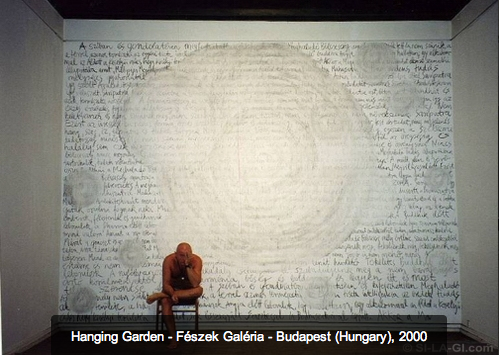
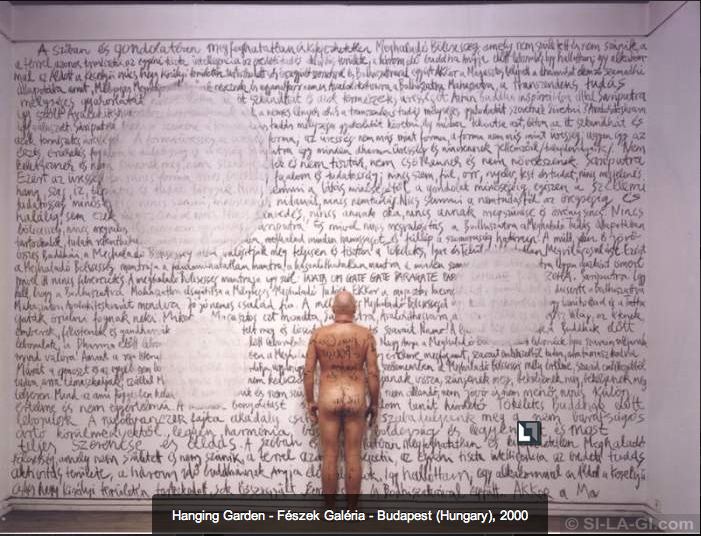
What I really enjoy about this piece is the effectiveness of the message while not imposing his western mindset. Instead, he looks at this traditional Japanese art form and repurposes it into a contemporary visual interpretation. The message that the Heart Sutra partly shares is the interconnectedness of all things, and how nothing stands independently with its own essence—Thus all things are “empty.” Buddhist philosophy tries to explain how emptiness is supposed be a beautiful thing because it means that we, and everything we know, actually exists. Buddhsim also gets to the point that that all things that exist are impermanent. Japanese rock gardens, in a sense, teach a sort of beauty that comes with impermanence. Here you see two forms of the same project. They were displayed simultaneously in the same location and in the same year. He also finds ways to interact differently with the piece, which suggets more of a constant movement and flow.
Sources:
http://www.si-la-gi.com/szabolcs-szilagyi/
http://www.si-la-gi.com/art-portfolio-gallery/
PROJECT 3 (03.27.2012): SKETCH
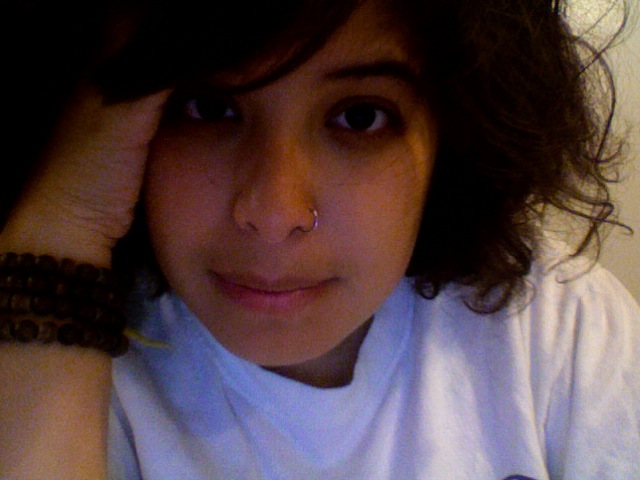
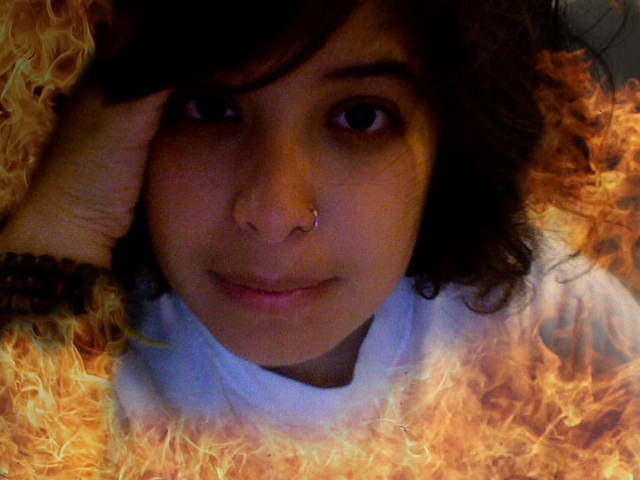
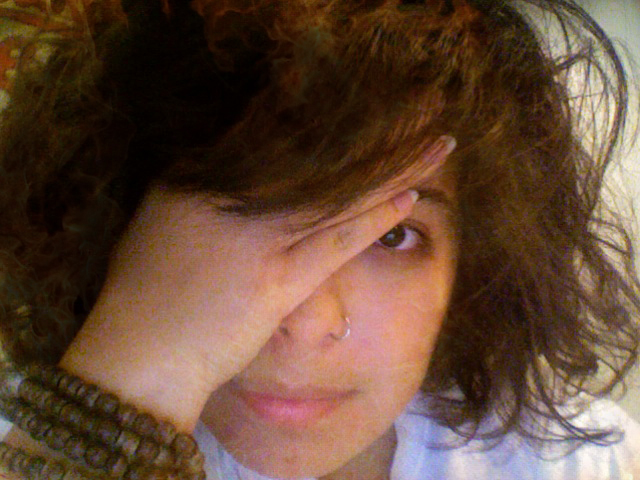
This is my first sketch to a “no-self, self-portrait.” As an Asian Studies major, I’ve studied a fair amount of Buddhist religion and philosophy. One of the most difficult concepts for anyone to grasp (even Buddhists) is the idea that there isn’t a “self” or that an essence is non-existing; this is the anatman. The argument is that for there to be an essence that stands on its own, then it has to be a totally independent and unchanging entity. The fact of the matter is that nothing is independent or unchanging. Everything is dependent of each other in one way or another in order to exist. In other words, if we had a “self” we would not exist, but there isn’t a “self” because we exist.
Below is a short parable of the Venerable Nagasena and King Melinda. There are countless parables that depict these two characters, but this particular parable relates to my project. Here, the Venerable Nagasena uses the example of a flame to illustrate the lack of “self.” For my project, I want to illustrate a changing and dependent self-portrait with the use of fire just as Nagasena explains below.
The king asked: "When someone is reborn, Venerable Nagasena, is he the same as the one who just died, or is he another?"
The elder replied: "He is neither the same nor another."
"Give me an illustration!"
"What do you think, Great King? When you were a tiny infant, newly born and quite soft, were you then the same as the one who is now grown up?"
"No, that infant was one, I, now grown up, am another."
"If that is so, then, Great King, you have had no mother, no father, no reaching, no schooling! Do we then take it that there is one mother for the embryo in the first stage, another for the second stage, another for the third, another for the fourth, another for the baby, another for the grown-up man? Is the school-boy one person, and the one who has finished school another? Does one commit a crime, but the hands and feet of another are cut off?"
"Certainly not! But what would you say, Reverend Sir, to all that?"
The elder replied: "I was neither the tiny infant, newly born and quite soft, nor am I now the grown-up man; but all these are comprised in one unit depending on this very body."
"Give me a simile!"
"If a man were to light a lamp, could it give light throughout the whole night?"
"Yes, it could."
"Is now the flame which burns in the first watch of the night the same as the one which burns in the second?"
"It is not the same."
"Or is the flame which burns in the second watch the same as the one which burns in the last one?"
"It is not the same."
"Do we then take it that there is one lamp in the first watch of the night, another in the second, and another again in the third?"
"No, it is just because of the light of the lamp shines throughout the night."
"Even so must we understand the collocation of a series of successive dharmas. At rebirth one dharma arises, while another stops; but the two processes take place almost simultaneously (i.e. they are continous). Therefore, the first act of consciousness in the new existence is neither the same as the last act of consciousness in the previous existence, nor it is the another."






SELF-ASSESSMENT 2:
When we started out this project, we divided into three groups. Out of those three groups, we were the group that was totally unsure about what to do for this project. We ended up running with the idea of a collaborative piece when we went out to explore potential spaces. Arriving at the campus center, we immediately gravitated towards the front of the campus center building. My biggest desire was to work with the space rather than work against it, and I am confident enough to say that we were able to accomplish just that.
Chrissy had the initial idea of paint dripping, and that made me think back to my final project from Experimental Media last semester. I originally wanted to work with projecting dripping paint before my idea shifted to the laser-light show after I realized how underdeveloped that idea was. I am really glad that I was able to go back to that concept and implement so many different perspectives to make it a more unique project. Working with three other people also served as a valuable learning experience. In fact, one of the artists I researched was actually a collaborative installation piece called Source Companion (2010) by Ayah Bdeir, Jeff Crouse, and Aaron Meyers. Their work really inspired and excited me for creating project two with a group of people. I looked forward to what I could learn from other members of my group as well as polishing the concept by talking about it with other people. I don’t believe that that project would have been anywhere near to the final outcome if we went our separate ways.
When we walked out to the Campus Center Patio and started brainstorming ideas, we quickly began to bounce our ideas off of each other. We first thought of recording actual paint dripping down the columns of the front side of the Campus Center. From there, our ideas kept going back and forth, and evolving. We went from simple paint dripping, to playing off of Emily’s paint sculpture to create a multimedia piece, to working with shadows, and simulating paint flowing out of the planters above the arches of the Campus Center.
We realized how difficult it would be to do any of these, so we got back together and started brainstorming again. In fact, we met a few times both at the site and in a room where we could draw out our ideas on a whiteboard. Emily introduced Patrick Connelly, a photographer that shoots multiple images in RAW from the same position and layers them so that you only see movement in the photo. He then saturates the colors of the motion in the photo in order to see just that movement. We realized that we could use a similar approach to our own project and save some paint.
The question then became, “How do we do this by using video instead of still images?” I took some of my masking techniques in Final Cut Pro and applied that to some experimental shots that Ryan and I did. To our surprise, it worked extremely well. We soon started to project what we had and make more videos using different liquid and backgrounds.
The entire projection came from two videos. Under the archway, we recorded water falling against a brick background. The columns were from a Coke or Pepsi drink being spilled over a saran-wrapped block of wood. In order to create the illusion of rainbow colored liquid spilling in different directions, Ryan suggested that we take small sections of the long clip and layer them over one another at different points of the timeline. This proved to be the simplest way to make it seem as though different colored liquid was being poured at different times.
By that point, Ryan and I were working on the kinks of our edits and going over it with Chrissy and Emily. We continued to go back to the space, project, and edit. Towards the final projection, we tried to work out ways to better include Emily and Chrissy into the physical project. We split up and were able to come back with our own edits, but given the constraint on time from rendering, it just was not possible to include everyone’s new edits—especially since some of us did not know what to do with certain parts of the projection.
Chrissy later came in wanting to add an extra element to the projection that we had not originally considered. We played around with the idea of large prints of stone that we thought would compliment the bricks that we were projecting on. We were not too set on that idea after we worked out some things with the projections themselves because it would take a lot more fabric than we had available, and would not make much sense conceptually. So, we went for plan B to use some of her prints from last semester that she never had the chance to print. I think that we were all really satisfied with how the prints and the projections worked with each other. Earlier, we discussed how we wanted people to experience the projection up close as well as from far away, and the prints really helped in closing that gap.
Time-wise, we had to cut down our projection’s running time from an hour to about 4 minutes. We wanted to project for an hour in order to prevent noticeable jump cuts when the clip looped. However, the rendering time was scheduled to finish a couple of hours after we were scheduled to begin projecting! We pretty much had to bite our tongues on this one and cut our running time down. As we set up our projection, I was worried that it would be very noticeable. Once it was up and running, we were all very pleased with the outcome, and it was not as bad as I had anticipated. In fact, not many people, if anyone, noticed the cut at all.
Perceiving the project as if it were not my own, there were different experiences while standing up against the projection as well as spectating it from far away. When coming up to the Campus Center and seeing the projection from far away, it was a very luring experience. The colors, patterns, direction, and movement were somewhat awing and trancing. Walking through the space and closer to the structure that was being projected onto, it was fun and playful to watch the pixels change color all over my body and the bodies of others. The hanging trees made the experience more dimensional and feel as though it was a misty and trippy world that I was experiencing. The only thing that I can see that could be tweaked would be to make sure that the projection on the columns was confined to the space of the columns. It seemed to bleed over to the back wall of the balcony a little bit, but was otherwise flawless.
I think that we deserve an A for this project. We worked very hard to test and edit every week, other than Spring Break. We pulled in our ideas, critiqued them, learned new ways to approaching a projection project, and learned how to collaborate with each other. This project would not have turned out as successful without all of our inputs, and that is what I think made such a strong outcome.
PROJECT 2 (03.27.2012): FINAL PROJECTION
Close-ups
PROJECT 2 (03.01.2012): PROGRESS
For this project, Emily, Ryan, Chrissy, and I are doing a collaborative piece that will be projected onto the arches of the Campus Center. Emily and Chrissy are both working more on the conceptual side of the project, while Ryan and I are working on the technical aspect. You can check out our concept ideas on Emily's and on Chrissy's websites. As for what Ryan and I have been working on, here it is:
This is a small scale sketch of what we are planning on projecting. After playing around with the idea of using paint, we thought it might be better to work with water and add color in FCP. This projection will be placed on one of the planters of the Campus Center's archway; the water will flow out of the planter and down to the ground.
RESEARCH 2 (02.28.2012)
Artist 1: (Collaborative)
Ayah Bdeir is a Lebanese-Canadian engineer and interactive artist. Her undergraduate degrees are in Computer Engineering and Sociology, she also has a masters degree from the MIT Media Lab. Her work includes
Jeff Crouse thrives on what he calls “the absurdity of technology.” His work includes software, web applications, installations, games, and video. He holds an MS in from the Digital Media program at Georgia Tech.
Aaron Meyers is a designer and programmer, focusing on moving images. He earned his MFA at the USC Interactive Media Division.
All three of these artists have been awarded a fellowship at Eyebeam Art + Technology Center. They have similar yet different interests, which is what drew me in to their collaborative work they created. The installation is called Source Companion, which was commissioned by White nightclub in Beirut in June of 2010.
Source Companion from ayah bdeir on Vimeo.
I really liked how they were able to draw in their strengths to create such an amazing installation. Source Companion is an interactive installation that processes algorithms to follow the audience when they walk through the hall of a nightclub where the installation is located, and creates abstract silhouettes depending on the audience’s movements as the walk by. The image looks almost like a digitized stream of color that follows across a canvas; it looks like an abstract, moving painting. They were able to create this work by using frameless LCDs, IR cameras, IR floods, custom software, and algorithmic animations.
An important aspect of the concept of the work is the teamwork that was involved in creating it. This makes me think of how for our second project, four of us are collaborating to create a work of art. Ayah, Jeff, and Aaron combined their strengths and focused disciplines to create a cohesive art piece. Just like them, we are going to bring in all of our strengths to do the same.
I enjoyed seeing the level of easy interaction between the audience and the artwork. In the video, it looks like many people are having fun with the installation and are really engaging and playing with the space. You see people who stop in the middle of the hall and wave their arms around to create a different image on the canvas every time.
If anything actually bothered me about the work, it would be the way that they decided to archive the work and present it to people who were not in the physical space of the project at the time of it being displayed. They recorded and documented their stay in Beirut and decided to include that in the video that serves as an archive for their work. They also included text that narrated what was going on, and outside music to be dubbed over the entire video. I just feel like it took away a little bit of the piece itself and almost created something completely different. I find myself clicking through different parts of the video timeline so that I can see just the footage of the installation.
Overall, I really like this piece. It speaks to how well a collaborative piece can work out in the end, which is what I am hoping for in our own collaborative artwork.
Sources:
http://www.jeffcrouse.info/about/
http://eyebeam.org/people/aaron-meyers
Artist 2:
Obscura Digital mentions on their website, "the world is our canvas." They are an advertising company that combines innovative digital technologies and digital art, and they certainly hold true to their quote. Obscura Digital’s team is comprised technology experts, art designers, and strategy specialists who work together to come up with mesmerizing and playful projections for their clients. Their clients mostly consist of big name companies. A few include: IBM, Google, Microsoft, Hardrock Café, Lexus, Audi, Skyy Vodka, McAfee, along with so many others.
Specifically referencing their projection on Mint Plaza, which was privately funded by McAfee (SF Appeal Online Newspaper), Obscura Digital combines artistic ideas and advanced technologies to project onto a space as if that space’s purpose was to serve the projection. In other words, the projections and Mint Plaza flawlessly seem to be a singular structure—they gave the feel of one not being able to exist without the other. Which of course we know that Mint Plaza can exist without the projections, and that the projections are dependent on the space that they are being projected onto. However, this display of seemingly seamless art makes you forget that the building is a static structure. The projections work well with the space and don’t try to combat against it. For example, the bouncing balls that ricochet off of the windows does just that. We are not looking at just a building with a projection over it, nor are we just looking at a projection of bouncing balls on a wall. They are part of each other to create the visual aesthetic that they achieved—to create an immersive and interactive experience.
This particular work relates to our work in the sense that we are really trying to work with the space as opposed to just projecting something onto a wall. Of course it would be very difficult to create this level dimension with the tools that we have available, but I also hope that we can use what we have to work with the space as best as we can. I am thinking specifically during 0:13 and 0:20 on the timeline from the piece that was projected onto Mint Plaza. The simulated liquid is moving across the space so organically, even with the windows in the way and t he different shades of brick on the wall. I know that one of our biggest concerns is being able to clearly project different colors of paint flowing down the brick walls of the Campus Center, and how that could potentially distort our image. We then, of course, have the upside that it might work in our favor.
I really do believe that it is all about working with the space, and Obscura Digital does a good job with that. There is a sense of a lot of preliminary research, sketches, and possibly even mock projections. It looks like a project like this must have taken a lot of teamwork from both technology experts and artists to pull in their strengths to project exceptional work.
Sources:
http://www.obscuradigital.com/about/
SELF-ASSESSMENT 1 (02.21.2012)
The first time I am introduced to a new project, I do my best to visualize the goals for the project, and identify what those goals try to accomplish. When we were first introduced to this project and were told to create a mash-up, I instantly thought of all the music videos I made with Windows Moviemaker and downloaded YouTube videos of cartoon characters when I was in high school. Because I am already somewhat familiar with this style of video editing, this project turned into one of those things in which I had to think outside the box and get out of my comfort zone. Although I know my way around the basics of video editing software like Final Cut Pro, there are still so many things in these programs that I am incredibly unfamiliar with. Having that idea sit in my mind for a bit eventually evolved into mashing up the images in my final video edit in a way that was not simply splicing video clips and then placing them next to one another.
First, I thought about different ways of approaching this project that would keep me from doing what I have done in the past; that was when I came to this idea of a narration. Initially, I wanted to illustrate the functions of the Internet and how stories unfold by clicking link after link. It reminded me of that game you play in elementary school where you sit in a circle, and someone starts out with one phrase tells it to the next person sitting next to them. Then, they add a second phrase to go with the first, and they tell the other person sitting next to them. They continue this pattern until they go all the way around the circle, thus creating a story. The question then became “How do I pick the initial phrase? Where do I start?” This sort of became a big issue because I did not want to discredit the entire basis of my concept—it had to flow as naturally as possible. I realized that the best way to get it rolling is to jump in, without question.
I headed to the same sites that I always start out with when I open my web browser: Gmail, Reddit, and Facebook. I realized that reddit.com is the best illustration to what I was thinking and thought it would be best to start in the video Sub-Reddit. I browsed through the first five videos, and their suggested links within Youtube, before becoming distracted, as it is the norm when browsing the Internet. The fifth video post from Reddit was titled “You can’t find talent like this anymore” that was linked to a video of Fred Astaire singing and performing to Puttin’ on the Ritz. The video was 4 minutes and 34 seconds long, with a link to a video of cats glaring at me from over on the right side of the screen. I just could not keep myself from clicking on that link, and that was when it hit me; this is the basis for my concept.
Having always known how the Internet can be a giant pool of distraction going from link to link, I decided to expand on my idea a little bit more. When it comes to the Internet, there is a kind of culture that comes with it. Videos and images of cats are amongst the most popularly viewed things in social networks such as YouTube and Reddit; so I thought that would be a good way to project a kind of rhythm in my mash-up that would display distraction. This was how I ultimately came up with my first sketch, and then eventually ended up with my final edit.
The research that we did for this project was extremely helpful in fine-tuning my idea. Coming across Marco Brambilla was what tied together my initial idea of a narration and distraction. Most of his recent work is extremely busy; his latest work, Evolution (Megaplex), especially. By creating a new story with bits and pieces of other stories, and then mixing them together in such a chaotic way, is basically how we function with the Internet. Our attention spans have shortened so much over the years that it has become difficult to even sit through Fred Astaire’s performance of less than five minutes!
I more or less randomly thought of The Beetles’ animated film The Yellow Submarine, and thought how well it would fit with my newly refined idea. Throughout the movie, the characters in the film are fairly difficult to understand what it is that they are talking about. Their dialogue is so quirky and can easily be mashed-up to make create a new story. I finally decided to pull out all of that seemed to be useful. I tried my best to mash up the dialogue with certain videos that I had been saving. I was not expecting this new video to cut between clips in the same fast pace that the sketch played at, but I wanted some kind of disorientation to happen between video clips. I thought that the best way to create that sort of disconnect was to have the illustrated images of The Beetles placed over the original YouTube video that I was working with.
Again, I did not want to simply splice images together, so I began to experiment with different effects found in Final Cut Pro. After browsing through a few different tutorials, I ended up mostly using Color Key and 8-Point Garbage Matte to juxtapose different cut outs of the cartoon version of The Beetles on a random selection of YouTube videos. I combined these effects and placed them one over the other until I received my desired result for how the cartoon images of The Beetles should look when placed over the other videos. I did come across some technical difficulties that were fortunately resolved for the most part. Sometimes certain garbage mattes would not register with other garbage mattes, as well as keys not registering with one or more keys.
Honestly, I tried my best to get an early start with the project. It turned out to be more time consuming than I imagined, and I was not quite sure how to structure the story. Once I pulled all of the dialogue, I had to make sure that they were effective comments to the videos playing in the background. I also had to figure out how to mend the background footage together with the overlaid footage. I found myself loving certain parts of the entire piece, individually; I did not love the entire thing put together. An example is where they are discussing the first footage of the mechanical-glove-ostrich, and then when they are talking about the gold fish ball later down the timeline. I really liked how the dialogue and background image went well in their respective section, but I found it very difficult to link it all together.
I think that this project needed a lot more time than I had anticipated. I thought that the most difficult part would be the technical aspect of cutting out the images and placing them over the other clips. Even then, I realized that it would be time-consuming, but I did not take into consideration the flow of the story. In a way I wanted it to be a little quirky and nonsensical, but on the other hand I really wanted it to flow.
The finished project actually feels unfinished. It is very short in comparison to what it could have been, but I also understand that there are deadlines. I think that it helped to have the characters talking as close to non-stop as possible because it keeps the viewer from fully registering the image in the back, which is what the project tries to keep you from doing. The most successful part of this project is how well the dialogue matched up to the cartoon characters’ commenting on whatever it was that was going on in the background. The weakest part of this piece is the story. It is not expected that the story have a complete beginning, middle, and end since that would ruin the quirky nature of their dialogue. However, it still seems that something is missing from their conversation. I think that making it at least three minutes longer would improve the piece greatly.
I think that the project deserves either a B+ or an A-. I think that there are some great ideas going on, and that there was a lot of experimenting and stepping into something that I have never done before; it has a lot of potential for being greater. However, I cannot help but notice that there is something missing. It is something that will take a lot more time than what I had before the project’s deadline, but for now I think it is where it needs to be.
PROJECT 1 (02.21.2012): A YOUTUBE COMMENTARY
RESEARCH 1 (02.07.2012)
Artist 1:
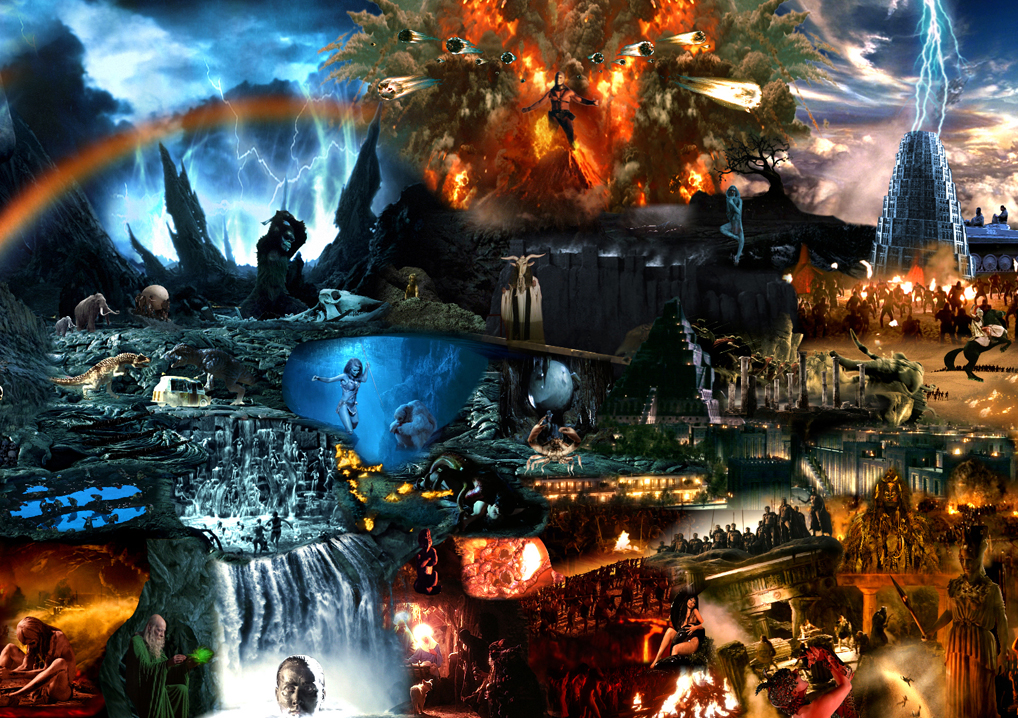
Marco Brambilla is a media and experimental film artist; he explores many different ways of combining images and video footage to the point where it becomes something that completely stands on its own. Brambilla recently showcased his latest work Evolution (Megaplex) (2010) at the Sundace Film Festival 2012, eight months after its debut at the Santa Monica Museum of Art. (VillageVoice)
Evolution (Megaplex) is the second part of a series called The Dark Lining, which follows the same general concept of video appropriation to display satirical approach to a specific idea—he is basically critiquing certain concepts that he addresses in his work. In the first part of this series, he created Civilization (Megaplex) (2008). Both of these works are a type of video mural that have looped clips placed in a collage form. The difference, however, is that they both have different messages that they are approaching, and the style of the piece is dependent on that message.
Civilization (Megaplex) is a satirical approach to “the concepts of eternal punishment and celestial reward,” (Brambilla) and the way that the piece moves and functions compliments that satirical approach. Evolution (Megaplex), however, is a satirical approach to the “bombast of the big-budget ‘epic’.” What he does here is that he adds another layer of dimension to his concept by adding in 3D technology.
Since Brambilla is commenting on the film industry’s method of luring people into the movie theatres buy selling a “real” and “natural” experience with watching 3D (LA Weekly), it makes sense for him to add in the spectacle that is the superfluous 3D technology found in films nowadays. In this collage, however, he creates a narrative of what he describes as being “the spectacle of human conflict across time through the lens of cinema.” (Brambilla). Halfway through working on Evolution (Megaplex), he added in 3D technology to emphasize how Hollywood took that same approach to many of their films, yet he still gave a different meaning to the 3D technology he used. He quoted in LA Weekly, "Evolution doesn't seek to duplicate the realism of 3-D films in Hollywood, where they're trying to make it feel like you're actually there."
This artist relates to my work, not so much because of direct concepts that he is describing to us, but more so for the underlying concept that I pulled out of his work the when I first saw it—before doing any research. Just by looking at the video, there was just so much going on in every different clip that is spread across the screen. My eyes kept moving all over the place, and it felt completely natural. VillagVoice coined the phrase “screen culture is evolving.” The way I read into that statement is that we are taking in so much information at such a fast pace, that it is no wonder that our attention spans are so short. In looking upon Brambilla’s Evolution, I scanned the entire screen section by section; I never looked at one section for more than a few seconds.
Although the work is so scattered when you look at each section, together it makes a cohesive piece. They are meaningless separately, but they get the message across really well when playing together and meshing into one another.
Screenshot of Evolution (Megaplex) in 2010:
Video of Evolution (Megaplex) at Sundace Film Festival New Frontier 2012:
Sources:
http://www.laweekly.com/2011-05-26/art-books/marco-brambilla-at-santa-monica-museum-of-art/
http://blogs.villagevoice.com/runninscared/2012/01/sundance_film_f_7.php
http://marcobrambilla.com/evolution.html
http://marcobrambilla.com/home.html
Artist 2:
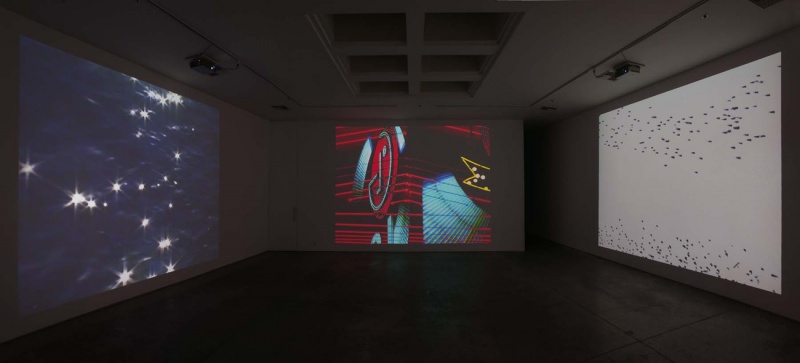
Takehito Koganezawa is a Tokyo-born, Berlin-based artist. He is a video-based artist who takes different approaches to how he uses the medium. I am, however, only going to focus on one approach he takes to creating his artwork. Over the years, (since 2005) Koganezawa has been going back to a particular project where he is projecting different clips next to one another, and playing them at the same time. Each clip compliments the ones next to it in order to create a singular artwork.
These video installations are more or less revisions of their predecessor, but they create a different meaning after each installation. His first attempt to this method was in 2005 with Dancing in Your Head. These were a series of clips that were intended to shuffle at random. Each clip was of any sound that you could possibly make with any common household item—paper ripping, glasses clinging, water running, and so on. Alone, all of these sounds can create rather obnoxious sound effects. However, Koganezawa was able to combine these clips so that your mind was forced to thread these sounds into something pleasant. (LA Times)
Following this framework came Dancing in Your Head (DIYH) Single Channel MOCA Remix in 2007. The difference here was that instead of displaying these clips on three separate walls, they would be right next to one another in one solid clip. The other difference is that the clips were no longer playing at random so that you end up hearing a different sequence each time; this revised version of DIYH seemed a bit more controlled.
In 2010, Koganezawa returned to the method he used in his original Dancing in Your Head piece from 2005 and projected different clips on separate walls that were right next to one another. This time, he used a different set of videos that served as a visual poem. (Art in America)
Koganezawa’s work relates to what I am working on for the first project in the sense that he took clips that alone have their own separate meaning as apposed to placing them next to one another, which in turn creates an entirely new meaning. Even then, it is important to keep in mind that any order that I place my own images in will create different meanings each time I were to switch them around—this is part of Koganezawa’s work that I can mostly relate on. Take the first two projects that I mentioned. They both had the same clips, but they became two separate projects in placing them so differently next to each other.
Photo of Takehito Koganezawa's Dancing in Your Head in 2005:

Excerpt from DIYH Single Channel MOCA Remix by Takehito Koganezawa, 2007:
Photo of Takehito Koganezawa's Video Installation in 2010:
Sources:
http://www.artinamericamagazine.com/reviews/takehito-koganezawa/
http://www.youtube.com/watch?v=LdUcbJoDhuo&feature=player_embedded
PROJECT 1 (01.31.2012): MASH-UP SKETCH